We Tend to Hide Behind Screens
16 November 2026 · Boris Manhart
AI makes it easier than ever to build something nobody wants. And easier to avoid finding that out.

Every call with a founder I was coaching seemed to begin with the same sentence: "We just need this one more feature, then the customers will sign."
The team was working hard. They had a product, a roadmap and plenty of conversations with potential customers. There was always something new to show. And they genuinely believed they were getting closer. But whenever we looked at the evidence together, the picture was less encouraging. No new customers. No real commitments. Just people saying things like, "I'd be interested if it could also do X."
So they went back and built X. And then the next customer wanted Y.
I see this quite often when working with early-stage startups. Founders come back from customer meetings with a list of requested features. They interpret those requests as validation. After all, why would someone ask for a feature if they weren't interested in buying?
Well, because most people don't enjoy saying no.
Imagine sitting across from an enthusiastic founder who has spent months building something. They've just given you a demonstration and are waiting for your reaction. You don't really need the product, but you don't want to disappoint them either. So you say it's interesting. You suggest a few improvements. Perhaps you mention a feature that would make it more useful for your organisation. Everyone leaves the meeting feeling reasonably good. The founder has a new development task. You've avoided an uncomfortable conversation.
Of course, sometimes the missing feature really is the problem. Enterprise customers have legitimate requirements. A product that doesn't integrate with existing systems or meet basic security standards may simply be impossible to buy. But there's a difference between a customer who says, "Build this and we'll buy," and one who says, "We might be interested if you build this." The difference is what they're prepared to commit.
I wrote recently about the gap between interest and demand. This is one of the easiest places to confuse the two.
We tend to hide behind screens
Building is comfortable. You have control over the process. You can plan the work, assign tasks, measure progress and eventually release something. At the end of the day, you have something to show for your effort. Customer conversations are much less predictable. You might discover that your assumptions are wrong, that the problem you're solving isn't important enough, or that customers understand your product perfectly well and simply don't want it.
That's difficult feedback to take, particularly when you've already invested months of your life in the idea. So you keep building. I don't think founders necessarily do this consciously. Most genuinely believe the next feature will make the difference. And sometimes they're right. But building can also become a way of postponing the moment when you have to confront reality.
We tend to hide behind screens. And AI has made those screens much more comfortable.
Until recently, adding another feature was a relatively expensive decision. It required developers, design work, testing and time. Even a small change could take weeks. That wasn't necessarily a bad thing. The cost of building forced teams to make choices. If a feature required three months of development, someone would eventually ask whether it was worth the investment. Perhaps they'd suggest speaking to a few more customers before committing.
Today, depending on the product, you can build a working version in an afternoon with AI. I think that's fantastic. It opens possibilities that would have been unthinkable for small teams only a few years ago. But there's a consequence we don't talk about enough.
When building becomes cheap, the pressure to justify what you're building can actually decrease.
Why challenge a customer's vague feature request when you can simply build it? Why have another difficult conversation when you can create a new prototype before lunch? And why stop?
AI coding tools don't get tired of your ideas. They don't question whether you should be building the feature in the first place unless you specifically ask them to. They'll help you implement it, improve it and suggest another five things you could add. You can spend an entire week making your product better without getting any closer to understanding whether someone wants it.
And there's another layer to this problem. AI can now help you prepare customer interviews, generate personas, simulate conversations and analyse feedback. These can be useful tools. I use AI myself, and I think it can make customer research more efficient. But simulated customers aren't customers. A convincing AI-generated persona can explain why your product might be useful. It cannot tell you whether a real person will take money out of their pocket to buy it.
You can end up with a polished product, a convincing pitch deck, detailed customer personas and a beautifully organised research report. All generated with AI. And still have no customers.
That's what concerns me. AI doesn't just make building easier. It can make the entire process of appearing to make progress easier. The danger isn't that AI produces bad products. It can produce remarkably good ones. The danger is that we can now produce increasingly convincing products without ever testing whether the underlying demand exists.
What one week could have told them
Back to the founder with the missing feature. Instead of building it, the team could have run a simple test. Go back to ten of the prospects who requested it. Show them what the feature would do. A mock-up or simple prototype would have been enough. Explain how it would work and what it would cost. Then ask for a commitment.
Not whether they like it. Not whether they would consider using it. Ask whether they're willing to sign a paid pilot, commit a budget or take another concrete step towards buying. The commitment has to mean something. A friendly email saying "Sounds great!" doesn't count.
And before running the experiment, decide what result would justify building the feature. For example, if three out of ten qualified prospects commit to a paid pilot, you proceed. If nobody does, you reconsider the assumption. Three out of ten isn't some universal product-market fit threshold. It's simply an example of a decision rule that you establish before seeing the results.
You might discover that the feature really was the missing piece. Or you might discover that people liked the idea but had no intention of paying for it. Either result would be useful. And you'd know within a week, rather than after several more months of development.
There's an important distinction here. A commitment isn't the same as revenue, and a pilot isn't proof of product-market fit. Customers can change their minds. Buying processes can collapse. Early evidence is always incomplete. But a meaningful commitment tells you considerably more than another enthusiastic conversation.
Faster building isn't faster learning
Much of the current discussion about AI in startups focuses on speed. How quickly can you build an MVP? How many developers do you still need? Can a single founder now build what previously required an entire team? These are interesting questions. But I think we're paying too little attention to another one: are we actually learning faster?
You can now build ten prototypes in the time it previously took to build one. That's valuable if each prototype tests a different assumption with real customers. But if you're simply building ten variations of something nobody wants, you've accelerated production without accelerating learning. In fact, you might have made things worse. Because every additional feature represents more work you've invested, and potentially another reason to resist evidence that the product isn't working.
The tools changed what it costs to build. They did not change what it means to learn.
You still need to understand a real problem. Find people who experience it. Observe their behaviour. Ask questions that might produce answers you don't like. And eventually, someone has to make a decision based on what you've learned. AI can help with almost every part of that process. But it cannot replace the evidence that comes from real customer behaviour.
I'm not suggesting founders should stop building. Quite the opposite. One of the best things about AI is that we can now test ideas that would previously have been too expensive to explore. But that only works if we treat what we build as an experiment.
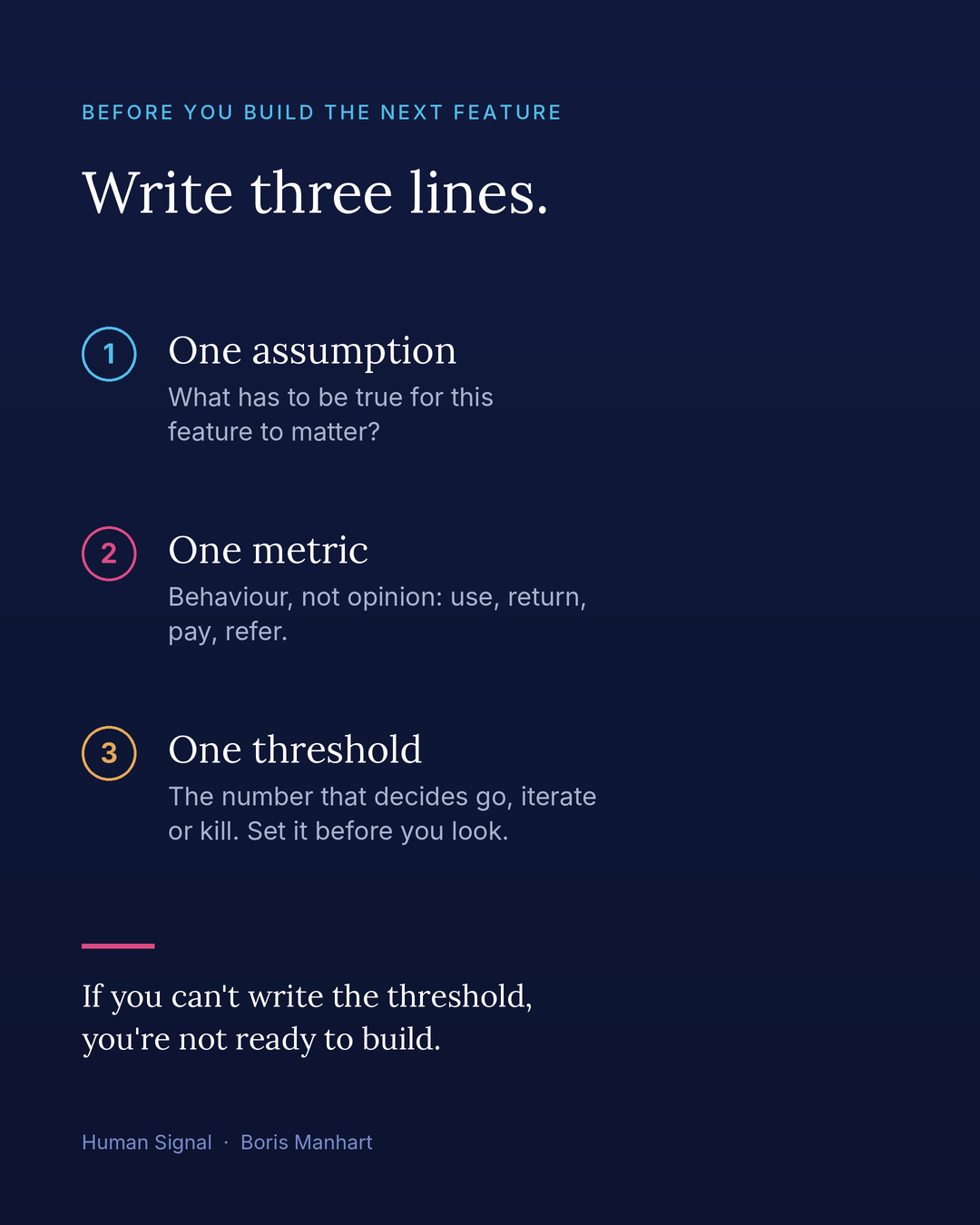
Before starting the next feature, write down the assumption you're trying to test. Decide what customer behaviour would support it and what result would make you reconsider. Then build only enough to test that assumption. Once the prototype is in front of real people, stop adding features for a moment. Watch what happens. Do people use it? Do they come back? Do they recommend it? Are they prepared to pay?
Even five real users can reveal important problems with a prototype. They won't establish product-market fit, but they may give you enough evidence to decide what to test next. And when the results come in, compare them with the criteria you set beforehand.
That's the difficult part. Because if you've already decided that your product is going to work, you'll find a way to interpret almost any feedback as encouragement.
The founder I was coaching didn't need another feature request. The team needed to find out whether anyone was prepared to commit to the product they were promising. Maybe the missing feature really was the obstacle. Maybe it wasn't.
But there's only one way to find out. And it doesn't involve spending another afternoon in front of your screen.
Test your assumptions before building the next feature.
The free Human Signal tools include an Experiment Canvas to help you define what you're testing, what customer behaviour matters and when to make a decision.
Download the six practical tools
Adapted from my book Human Signal: How to Find Real Product-Market Fit in an AI-Built World.
- AI
- Startups
- Founder