Build a Validated, Sellable Product in 3 Days
23 November 2026 · Boris Manhart
The Three-Day Product, Part I: The Theory. Validate the need before you build it.

A few years ago, telling a founder to build a product in three days would have been ridiculous. Today, with AI, it's becoming a realistic proposition. At least for certain kinds of software.
But I want to take the idea a step further.
Can we build a product in three days that people actually want and are willing to pay for?
I don't know. But I think it's worth finding out.
And to be clear about the word "validated": I don't mean statistically proven. Five interviews and a handful of early users won't give you that. What they can give you is a good sense of direction, based on what real people do rather than on your own enthusiasm. For a three-day experiment, that's the right bar.
The interesting part isn't whether AI can generate a functioning application in three days. We've seen enough examples of that by now. The interesting part is whether we can combine that speed with a disciplined approach to finding real demand.
Because building something and building something people want are still two very different things.
The problem with being busy
There's a particular kind of startup I come across quite often. The team is working hard, the product keeps improving, new features are released almost every week, and the founders can give you a detailed account of everything they've accomplished. They have roadmaps, KPIs, customer meetings and enough digital Post-its to wallpaper a small office.
And yet, when I ask what they've actually learned about their market in the last three months, the conversation becomes surprisingly difficult.
They can tell me what they've built. But it's much harder for them to explain what they now know that they didn't know before. Or which assumption turned out to be wrong.
I've been there myself. When you're responsible for a company, doing something feels considerably better than waiting for evidence. Your team needs direction, your investors expect progress, and there's always another problem you can solve. Building gives you something tangible. Learning is less comfortable, especially when what you learn suggests you've been working on the wrong thing.
AI makes this tension more interesting. When building was expensive, you had to think carefully about what deserved to be built. Today, you can often just build it and see what happens.
That's a fantastic opportunity. But it can also become a very efficient way of avoiding difficult questions.
So what if we reversed the process? What if we spent our time validating the need first and only then used AI to build the product?
The PMF Flywheel
One of the reasons I developed the PMF Flywheel was to help founders answer a question that sounds almost embarrassingly simple: where are we actually in the process of finding product-market fit?
The Flywheel has four quadrants: Market Selection, Problem-Solution Fit, Value Proposition, and Build & Learn. At the centre is Validated Learning, and an outer arrow, Expand to Next Market, leads on to the next market.
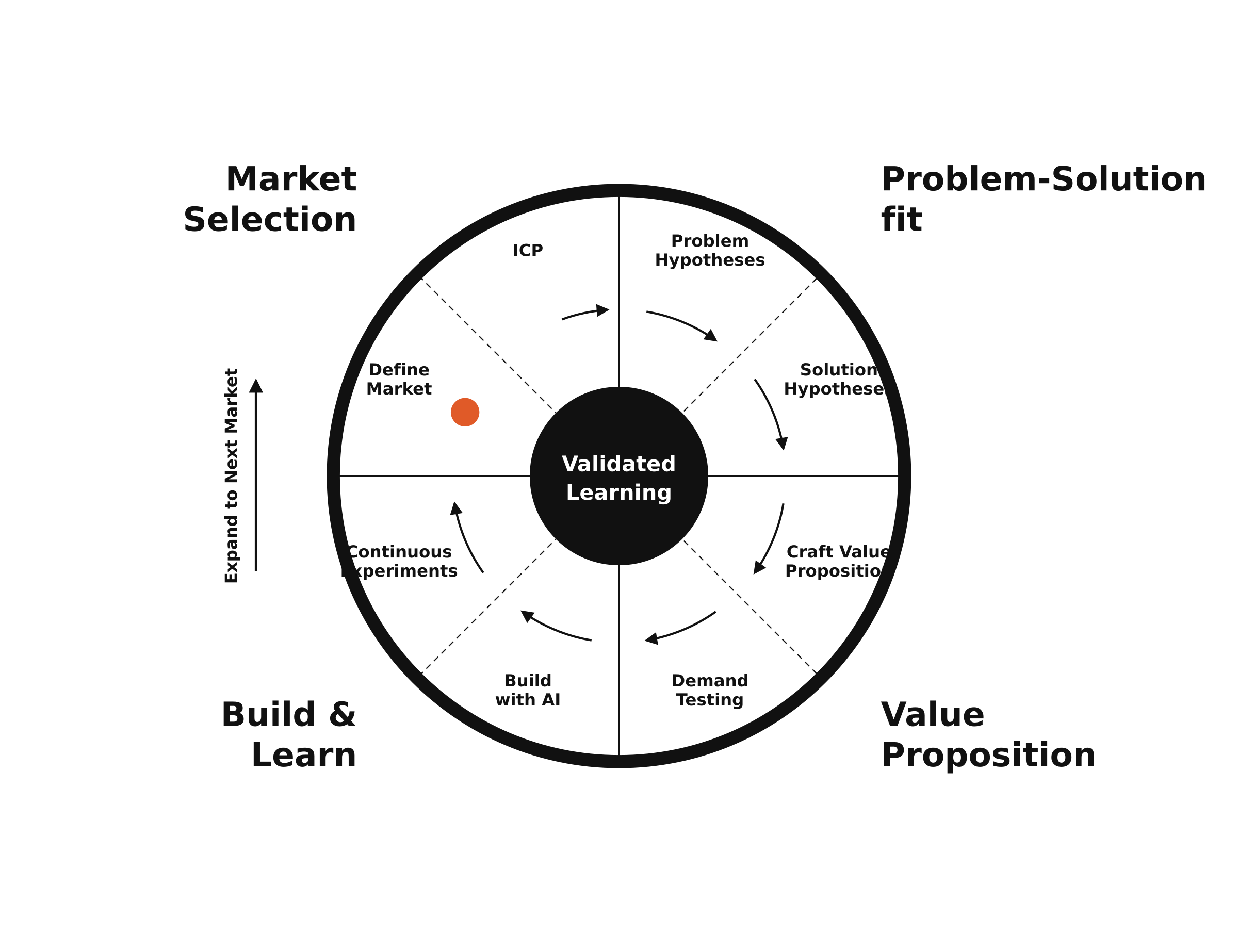
The order matters, even if real startup life rarely follows a neat sequence.
Market Selection is about choosing a market worth pursuing. Who are the customers? Can you reach them? Is there a meaningful opportunity? Problem-Solution Fit asks whether you've identified a problem that matters enough for those customers to do something about it. Value Proposition is where you establish whether your proposed solution gives them a compelling reason to change their behaviour. And Build & Learn is where you develop and improve the product based on what customers actually do.
I see teams who believe they're in Build & Learn because they're building something and collecting feedback. But when we examine the evidence, they're still trying to establish whether the problem is important enough. They're improving a solution before they've established the need.
More development won't necessarily help them. They may need to revisit assumptions they thought they'd already settled.
That's not going backwards. It's finding out where you really are.
The most important part of the Flywheel is actually in the middle: Validated Learning. Something you know because real people have demonstrated it through their behaviour.
A customer telling you your idea is interesting isn't the same as a customer agreeing to pay. Someone saying they'd use your product isn't the same as someone actually using it. Both conversations can be useful, but they answer different questions.
And that's where I think we can make the three-day experiment interesting.
Five interviews during three days of building
Here's the idea. Before the sprint begins, we identify a specific Ideal Customer Profile and recruit five people who fit it. We schedule their interviews and any necessary follow-up conversations in advance. The conversations themselves, and the work of making sense of what we hear, are part of the sprint. Otherwise, the three-day sprint quickly becomes a three-week exercise in finding people who have time to talk.
Why five? Because for an initial qualitative investigation, five carefully selected conversations can often reveal recurring problems and challenge our assumptions. They won't establish product-market fit, and they won't tell us how large the market is. But they can give us a much better sense of direction than our own enthusiasm.
There's a catch. Recruiting the right people may take longer than building the product itself.
I think that's rather telling.
We can generate code almost instantly, but we still need real people to understand whether we're solving something worth solving.
The interviews need to focus on actual behaviour. How do people deal with the problem today? What have they tried? What does the problem cost them? Have they spent money or time trying to solve it? What would make them change?
If the answers suggest there's no meaningful problem, we should be prepared to stop. Or choose another market.
If we find something worth pursuing, we move forward with the sprint.
Three days, four quadrants
On Day 1, we work through Market Selection and Problem-Solution Fit. We conduct the interviews, examine the evidence, narrow the target market and decide which problem we're actually trying to solve. The output isn't a product specification. It's a clear problem hypothesis supported by what we've learned.
On Day 2, we develop the Value Proposition. What exactly are we offering, to whom, and why would they choose it over what they're doing today? We can use mock-ups, a landing page or a simple demonstration to make the offer concrete. Then we test it with potential customers and look for meaningful commitments. In the Flywheel, that's Demand Testing. Interest is encouraging, but we're particularly interested in what people are prepared to do.
On Day 3, we build. With AI, a small functional product may be entirely realistic in that time. Not a polished commercial application, but something real enough for customers to try. Then we put it in front of users and, over the following weeks, observe what happens.
The sequence is deliberately simple. But it doesn't mean we can declare success after three days.
A working prototype isn't product-market fit. Five interviews won't validate a market statistically. And a few positive reactions don't prove that we have a business. But together they can tell us whether we're heading in the right direction.
What we should have is something more useful than another impressive demo: a product built around a problem we've investigated, a value proposition we've tested, and a clear understanding of which assumptions remain unproven.
Whether people will actually buy it is exactly what we want to find out.
Let's test the theory
I could leave this as another framework and tell you to try it yourself.
But I think it would be more interesting to put it to the test.
Over the next few days, my co-founder Marc Pittner and I are starting a small product project. Marc is building the app. It's based on a problem I've experienced personally, and I've already spoken to other people who recognise it. There's an initial idea, a possible market and a product we believe we can build quickly with AI.
That's about as far as I'm willing to go with the claims for now.
We still need to examine the assumptions properly, work through the PMF Flywheel and see whether there's a real opportunity behind the idea.
In Part II, I'll introduce the product, explain the problem we're trying to solve and show how we apply the Flywheel in practice. Including the decisions we make before building and what AI actually allows us to accomplish in three days.
Then, in Part III, we'll look at the results. Did people use it? Did they come back? Was anyone willing to pay? And what did we learn that we didn't know before?
I don't know how this will turn out. We might find a real opportunity. We might discover that people recognise the problem but don't want our solution. Or that they like the product but aren't willing to pay.
All three would tell us something useful.
The point isn't to prove that AI can build a product in three days. It's to find out whether we can get to meaningful customer evidence faster.
And whether I'll be disciplined enough to follow my own advice when the evidence isn't what I hoped for.
Try The PMF Flywheel
The PMF Flywheel is one of six free practical tools available alongside my book *Human Signal: How to Find Real Product-Market Fit in an AI-Built World*.
Start with the Flywheel. Be honest about which quadrant you're really in. And before you build your next feature, ask yourself what you actually need to learn.
Download The PMF Flywheel and the other free tools: https://human-signal.ai/downloads?utm_source=substack&utm_medium=essay_footer&utm_campaign=sustain_w48&utm_content=pmf_flywheel
Adapted from ideas in my book Human Signal: How to Find Real Product-Market Fit in an AI-Built World, out now as paperback and e-book.
- Product-Market Fit
- Customer Discovery
- Startup